If you are a tenant: Missouri law lets a landlord keep part of a deposit to fix damage, but not for ordinary wear and tear. A small floor repair before you move out can cost less than what would come out of your deposit.
If you are a landlord: Floors are one of the most common deposit disputes. Clear move-in photos and a floor that can be repaired one plank at a time make turnovers faster and arguments shorter.
This guide explains the law in plain terms. It is not legal advice.
Renting in St. Joseph
About 39% of occupied homes in St. Joseph are rented, by the Census Bureau's latest survey count. That is a lot of floors changing hands every year.
What Missouri's deposit law says
Missouri's security deposit statute, RSMo 535.300, in effect since August 28, 2018, says in substance:
- Cap. A landlord cannot take a security deposit of more than two months' rent.
- 30 days. Within 30 days after the tenancy ends, the landlord must return the full deposit or give the tenant a written, itemized list of damages along with any balance left.
- What can be kept. Apart from unpaid rent and a few other items, the landlord can only withhold what is reasonably needed to put the unit back in the condition it was in when the tenancy started, with ordinary wear and tear excepted.
- Carpet cleaning. If the rental agreement sets out the fees and tells the tenant they may be charged, the landlord can charge the actual cost of carpet cleaning, with a receipt provided within 30 days after the tenancy ends.
- Inspection. The landlord has to give the tenant reasonable written notice of the date and time of the move-out inspection, and the tenant has the right to be there.
- Wrongful withholding. A tenant who is wrongfully denied any part of the deposit may recover twice the amount withheld.
Read the statute itself for the exact wording, and talk to a lawyer about a specific dispute.
Floor damage versus floor wear: practical examples
The statute does not define damage or wear for floors. These are common examples to help you sort it out, not legal rules:
| Usually wear | Usually damage |
|---|---|
| Light traffic patterns in carpet | Burns, large stains or pet urine soaked into carpet or pad |
| Fine surface scratches on hardwood or vinyl plank | Deep gouges, dragged-furniture scrapes, pet claw damage across a room |
| Slight fading near a sunny window | A swollen area from a plant pot or a fish tank leak |
| Seasonal gaps in wood floors | Planks pulled apart or broken |
| Grout darkening over time | Cracked tiles from a dropped heavy object |
For tenants: small fixes before the walkthrough
- One or two lifted or broken vinyl planks
- A cracked tile
- A gouged hardwood board
- A torn transition strip at a doorway
- A carpet seam or a small burn that can be patched
Each of those is usually a small repair, and fixing it before the inspection means the landlord has less to list. See floor repair for how each one works, and what repairs cost.
For landlords: repair or replace between tenants
- Repair when the damage is in one area and the rest of the floor is sound. Replacing a few planks is far cheaper than a new floor.
- Replace the floor in a room when damage runs across most of it, the floor has failed more than once, or the subfloor needs work.
- Plan for the next repair. Floors that can be fixed one plank or one tile at a time, and a box of spare material kept on site, make the next turnover simpler.
If a water leak was involved, start with water-damaged floor repair. If the unit is in a basement, read basement floors and water.
Older rentals and lead. EPA's lead renovation rule covers landlords and property managers doing work that disturbs paint in rental homes built before 1978 (EPA).
A photo record of the floors, start and end of the lease
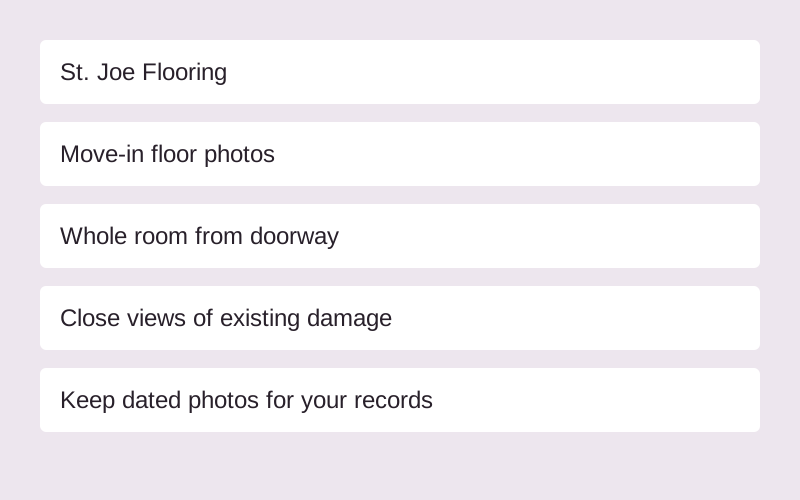
- A doorway shot of every room, wide enough to show the whole floor
- Close photos of every existing scratch, stain, chip or lifted edge, with something for scale
- Thresholds, transitions and the floor in front of the kitchen sink, tub and toilet
- Under where appliances sit, if they can be pulled out
- The same shots, from the same spots, at move-out
Timing a repair before a move-out
Send photos as soon as you know the move-out date, so there is time for the quote and the work before the inspection.
Sources
- U.S. Census Bureau, American Community Survey 2024, St. Joseph city, Missouri: tenure, via Census Reporter
- Missouri Revisor of Statutes, RSMo 535.300
- U.S. EPA, Lead Renovation, Repair and Painting Program