Nearly every floor problem in a St. Joseph house is a repair, not reasons for a new floor. A squeak is two pieces of wood rubbing. A lifted plank is usually a locking edge that let go or a spot of moisture. A cracked tile is often one tile, or a sign of movement in the floor below it. We find which one you have, fix that area and leave the rest of the floor alone.
Squeaky floors
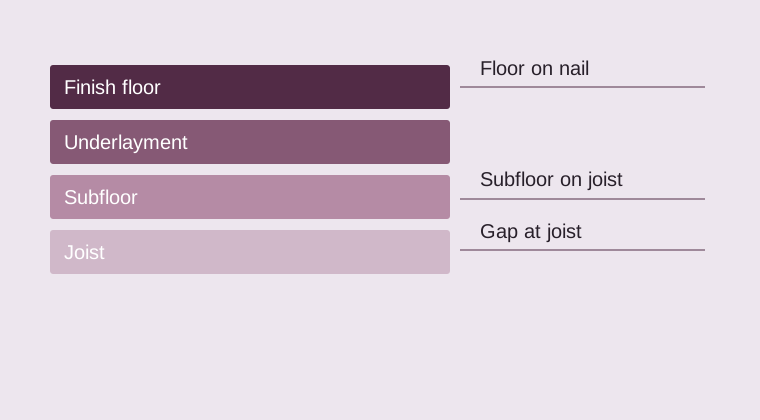
A floor squeaks when something moves that should not: a subfloor panel riding up and down on a nail, a board rubbing its neighbor, or a space that has opened where the subfloor rests on a joist. The fix depends on where you can reach.
- From below. If the floor is over an unfinished basement, we can often work from underneath, closing gaps at the joists and fastening the subfloor up tight. Nothing on the finished side gets touched.
- From above. Over a finished ceiling or a crawl space, the subfloor gets pulled down to the joist with screws driven through the finished floor. On carpet, there are fastening systems that go through the carpet and snap off below the pile. On hardwood, the screw is countersunk and the hole is filled to match.
Squeaks that run along a whole line across a room usually point to one joist that has dropped or dried away from the subfloor above it.
Lifting, gapping or peaking vinyl plank and laminate
A floating plank floor moves with temperature and humidity. Most trouble comes from one of three things:
- No room to move. Planks pushed tight against a wall, a cabinet or a door frame have nowhere to go in summer, so they peak at the seams. Trimming the edge to give back an expansion gap often settles it.
- Separated ends. Short gaps that open at the ends of planks usually mean a locking edge has failed or the floor is not flat underneath. The damaged planks come out and new ones click back in.
- Moisture from below. Planks that swell or lift near a dishwasher, fridge or exterior door have often taken water. That is a water-damage repair, and the source gets fixed first.
On a floating floor we can usually take apart the nearest wall to reach a damaged plank. Glue-down planks come out one at a time.
Hardwood: damaged and loose boards, and winter gaps
A gouged, stained or split board can be cut out and replaced with a new one woven into the pattern so the joints still stagger. Loose boards get fastened back down to the subfloor. Pet stains that have gone black in the wood are usually a board replacement, not a sanding job.
Gaps between boards that open in winter and close in summer are wood reacting to dry heated air. Seasonal gaps are normal and usually are not a repair. Gaps that stay open all year, or that grow wider every season, are worth a look because they can point to moisture or a subfloor that is moving.
This page covers repairs to boards and small areas. Sanding and refinishing a whole floor is separate work.
Tile: one cracked tile, hollow tiles, and long cracks
- One cracked tile is usually a single-tile repair: grind out the grout, take out the broken tile, set a new one and regrout. A spare tile from when the floor went in is the best match.
- Hollow tiles sound different when you tap them because they are no longer fully bonded to what is below. One or two can often be reset. A whole area of hollow tiles points to a problem with the setting bed or the subfloor.
- A crack that runs across several tiles in a line almost always follows something underneath, such as a seam in the subfloor or a crack in a slab. Replacing the tiles without dealing with that line means the crack comes back. See subfloor repair if the floor flexes.
Sheet vinyl and old resilient tile in pre-1980 houses
Old sheet vinyl, 9 inch square tiles and the black adhesive under them can contain asbestos in houses from before 1980. Missouri's Department of Natural Resources says that adhesive must not be dry scraped or sanded, and that sheet vinyl's backing is treated as friable when it is exposed (Missouri DNR). EPA's advice is to leave material alone when it is in good condition and to have it tested before it is disturbed (EPA). If your repair involves old resilient flooring, read our guide to old floor tile and asbestos first. When we find suspect material, we stop and tell you before anything is disturbed.
Transitions, thresholds and stair nosing
Worn or loose transition strips catch toes and let plank edges chip. Thresholds at exterior doors take the most water and traffic in the house. Stair nosing on a plank or laminate stair can work loose and become a trip hazard. These are small repairs that make a floor safer and keep the edges of the main floor from breaking down.
Matching discontinued material
Flooring lines change often, and a plank that was sold when your floor went in may not be made anymore. Our approach:
- Look for spares in the garage, attic or a closet.
- Take planks from inside a closet or from under the fridge, and put the closest new material in their place, where nobody will see it.
- If none of that works, find the closest current product and show you how close it is before we start.
We will not promise a perfect match we cannot get.
When a repair stops being worth it
Angi lists repair costs that run past half the price of new flooring as the first sign that replacing makes more sense (Angi). Other signs are damage that has spread across most of the room, a floor that has failed in more than one way, or a subfloor problem that means the finished floor has to come up anyway. In those cases we take up the floor in that room, fix what is below and put a floor back down. See what repairs and room replacements cost.
What to send for a quote
- A wide photo of the room and a close photo of the problem
- What type of floor it is, if you know
- About how big the area or the room is
- Whether there is a basement, a crawl space or a slab underneath
- When the problem started, and anything that happened just before it, like a leak
Request a written repair quote, or go back to the St. Joe Flooring home page.
Floor repair questions
Can a squeak be fixed without lifting the carpet?
Usually, yes. If there is an open basement below, the fix often happens from underneath. If not, special screws go through the carpet into the joist and break off below the pile, so the carpet stays down and the hole disappears.
Why do the gaps in my wood floor open in winter?
Heated winter air is dry, and wood gives up moisture and shrinks as it dries. The boards swell back in humid summer weather. Seasonal gaps like that are normal. Gaps that stay open all year deserve a closer look.
Can you change a single cracked tile?
Yes, in most cases. The grout around it is ground out, the broken tile comes up, and a new one is set and grouted. A matching spare tile makes the repair close to invisible.
Do I need a city permit to repair a floor in St. Joseph?
The City of St. Joseph lists flooring among projects that do not need a permit. Remodeling, basement finishes and structural modifications are on its list of projects that do, and the city notes the list is not complete (City of St. Joseph).
Sources
- City of St. Joseph, Building Development
- Missouri Department of Natural Resources, Management of Nonfriable Asbestos-containing Materials (PUB2156)
- U.S. EPA, Protect Your Family from Exposures to Asbestos
- Angi, cost to repair flooring