Before any floor goes down in a basement, find out where the water comes from, check the slab, and choose a floor that can live with some moisture. A good floor over a wet slab fails just as fast as a cheap one.
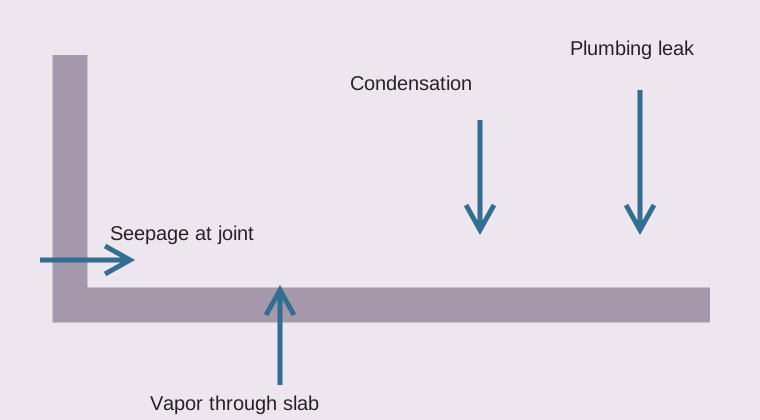
Where basement water comes from
- Moisture rising through the concrete. A slab is not a sealed surface, and ground moisture works its way up constantly, even on a floor that looks bone dry.
- Seepage at the wall joint. After heavy rain, water often shows up first where the walls meet the floor.
- Summer condensation. Warm, humid air hits the cool slab and walls and condenses, especially in July and August.
- Plumbing. Water heaters, washers, softeners and supply lines all live down there.
- Drains backing up. A floor drain that backs up in a storm brings contaminated water in from below.
Check your flood risk
St. Joseph sits on the Missouri River. If you want to know whether your house is in a mapped flood hazard area, the city's proposed flood maps page explains how to find the map panel for your area through FEMA, and current maps are on FEMA's Flood Map Service Center. A flood zone is a different question from a damp basement, but both affect what floor makes sense.
Checks a homeowner can do
- A taped plastic sheet. Seal a two-foot square of clear plastic to the bare concrete with tape along every edge and wait a couple of days. Droplets under the plastic mean moisture is coming up through the slab. Droplets on top mean the air is humid.
- White deposits. Chalky white powder on the slab or walls is mineral left behind by water passing through.
- Your nose after rain. A musty smell that gets stronger after a storm means water is getting in somewhere.
- Stains at the base of the walls and rust on the feet of appliances.
Simple checks like these show whether moisture is an issue. The written instructions for the floor you choose set the moisture test and the limit that floor needs.
Which floors hold up on a basement slab
| Floor | Over a basement slab |
|---|---|
| Ceramic or porcelain tile | Handles moisture well; the slab has to be sound and flat |
| Vinyl plank with a waterproof core | Usually a good choice; check the maker's moisture limits and underlayment rules |
| Sheet vinyl | Tolerates moisture; follow the maker's slab requirements |
| Engineered wood | Depends on whether the maker approves it for basements |
| Laminate with a wood-fiber core | Risky; the core swells if water gets into the edges |
| Solid hardwood | Not a basement floor |
| Carpet and pad | Holds moisture and odor; a poor choice if water ever gets in |
Permits for basement work
The City of St. Joseph lists flooring as work that does not need a permit, but it lists basement finishes as work that does (City of St. Joseph). Putting a floor down is flooring. Framing walls, adding a ceiling and turning the basement into living space is a basement finish.
Old basements
Many older St. Joseph basements have stone or brick foundation walls, slabs that were painted or patched over the decades, and slabs that are uneven or sloped toward a drain. Some still have old square tile glued to the concrete. If yours does, read old floor tile and asbestos before anyone scrapes it up.
Fix the water first
We are not a waterproofing company. If the checks above show water coming in, get the grading, gutters, downspouts, cracks or drainage dealt with first. A floor is the last step, not the fix.
If your basement floor already got wet, see water-damaged floor repair. For published ranges on room replacements, see the floor repair and replacement cost guide. When the basement is dry and you are ready, send photos of the slab and the room, and we will quote a basement floor repair or replacement.
Sources
- City of St. Joseph, Building Development
- City of St. Joseph, Proposed Flood Maps
- FEMA, Flood Map Service Center