If your house has old square floor tiles, old sheet vinyl or black adhesive under a newer floor, do not sand, scrape or grind it. Have it tested before it is disturbed. A floor that is in good condition can often stay where it is and be covered, which is usually the simplest and cheapest path.
This guide explains what Missouri and federal guidance say. It is not advice to remove anything yourself.
Why this comes up so often in St. Joseph
Roughly three quarters of the city's housing was built before 1980 (Census Bureau). Many of those houses have had their floors redone more than once, and the older layers are often still there under the newer ones.
Which materials are suspect
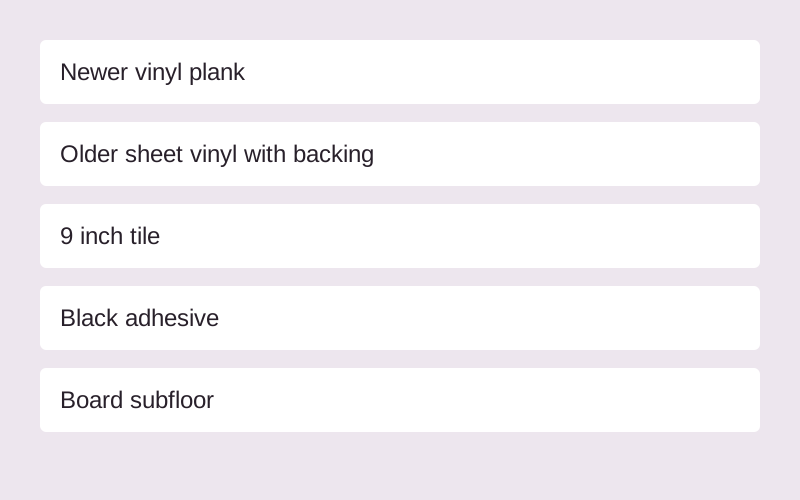
- Resilient floor tile, especially 9 inch by 9 inch tiles, in vinyl or asphalt
- Sheet vinyl and linoleum-style sheet flooring, mainly the felt-like backing on the underside
- Black adhesive (mastic) under old tile or sheet flooring
You cannot tell whether a material contains asbestos by looking at it. EPA says that if you are unsure, treat it as if it does and leave it alone (EPA).
What Missouri's Department of Natural Resources says
Missouri DNR's guidance on nonfriable asbestos materials (PUB2156) covers each of these:
- Floor tile is not regulated as long as it is in good condition and is not made friable, meaning crumbled or pulverized. Tile taken up by hand in largely intact pieces, kept wet throughout, can come out as an unregulated project. Breaking it up, or using machines or bead blasters on it, makes it regulated.
- Sheet vinyl backing is treated by the department as inherently friable. To come up without regulation, sheet vinyl has to stay attached to the subfloor so the backing is never exposed.
- Black adhesive is not regulated while it is in good condition and not made friable. DNR says it "must not be dry scraped or sanded," and that sanding, grinding, cutting or abrading it during removal makes it regulated.
EPA's household advice points the same way: do not sand or level asbestos flooring or its backing, never use a power stripper on it, and if the floor needs replacing, put the new floor over it when possible (EPA).
Who the inspection rules bind
Missouri DNR's requirements for asbestos in demolition and renovation projects include an exception for "a single residential structure that contains four or fewer dwelling units," and DNR adds that projects involving two or more residential structures are not exempt (PUB2157). That exception concerns which projects fall under those state requirements. It does not make old tile safe to break up, and the work practices above still matter in a house.
Testing
A test means a small sample of the tile, sheet or adhesive is taken and sent to a lab. For anyone planning a remodel, or with material that is already damaged, EPA recommends an inspection by a trained and accredited professional, and says taking samples yourself is not recommended (EPA). Missouri DNR keeps a list of the asbestos inspectors it certifies and a list of registered asbestos abatement contractors on its asbestos website (PUB2157).
Your options
- Leave it and cover it. If the old floor is flat, sound and staying intact, a new floor can often go right over it. Nothing gets disturbed.
- Encapsulate it. Seal the old floor in place under an underlayment or a coating, then put the new floor on top.
- Have it removed by a registered abatement contractor, when the floor has to come out for a subfloor repair or the old layer is damaged.
When we open a floor and find suspect tile, sheet vinyl or adhesive, we stop and tell you before anything is disturbed.
What this does to a floor quote
Testing and any abatement are separate from the floor repair itself. HomeAdvisor's cost-factor table lists asbestos removal at $5 to $20 per square foot (HomeAdvisor). Leaving the old layer in place and covering it avoids that cost entirely when the floor allows it. For the rest of the numbers, see our floor repair and replacement cost guide.
Related reading
Finding old tile is common when people go looking for wood under carpet; see hardwood under carpet. If the floor under the tile is soft, read subfloor repair.
Sources
- U.S. Census Bureau, American Community Survey 2024, St. Joseph city, Missouri: year structure built, via Census Reporter
- Missouri Department of Natural Resources, Management of Nonfriable Asbestos-containing Materials (PUB2156)
- Missouri Department of Natural Resources, Asbestos Requirements for Demolition and Renovation Projects (PUB2157)
- U.S. EPA, Protect Your Family from Exposures to Asbestos
- HomeAdvisor, flooring cost guide